Financial AI agents are no longer being judged only by whether they can answer a market question. The harder test is whether they can participate in a workflow over time without losing context, repeating the same mistakes or forcing users to manually rebuild the agent’s memory at every step.
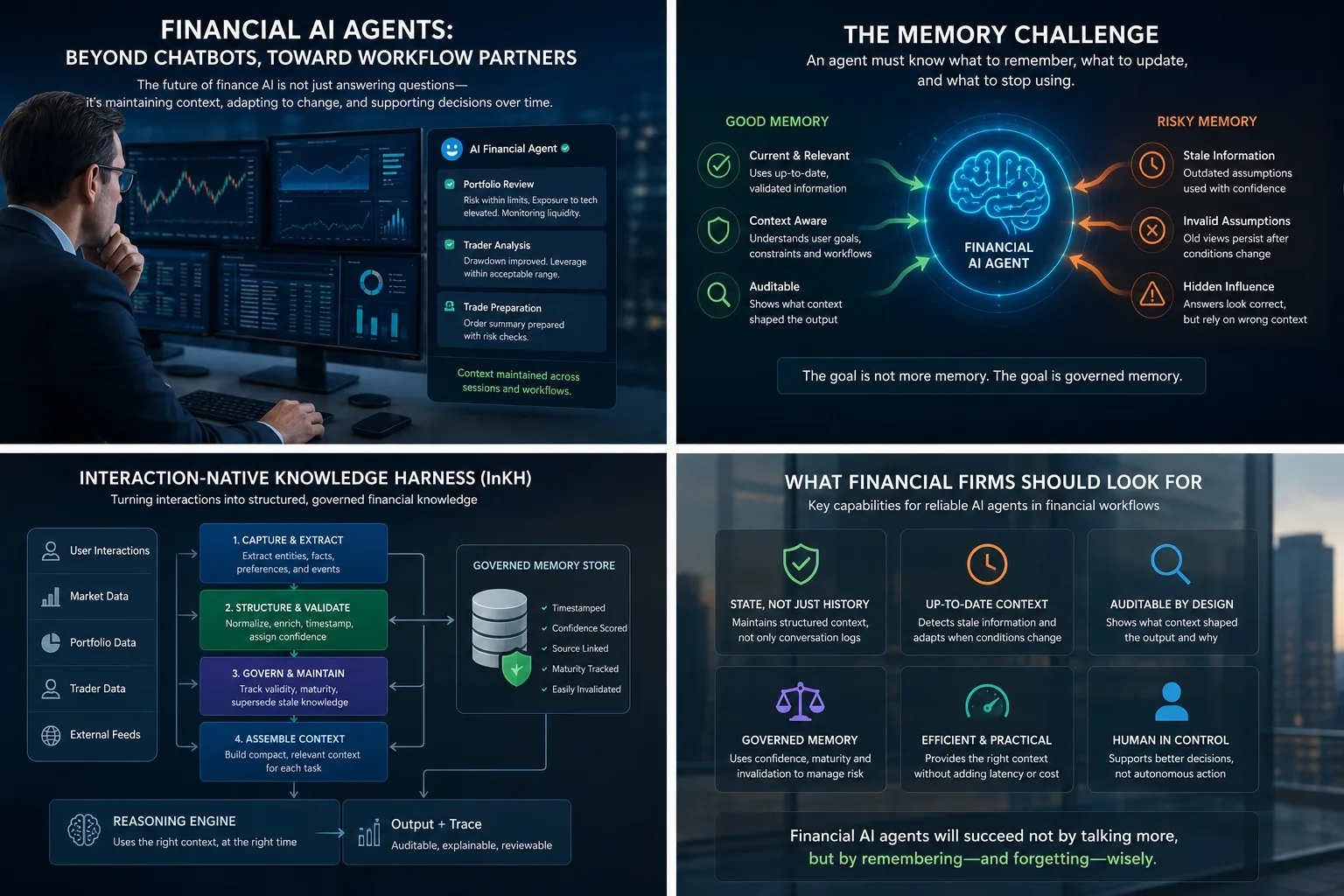
That is the broader issue raised by a new arXiv paper authored by Ailiya Borjigin, Igor Stadnyk, Ben Bilski, Maksym Chikita, Dmytro Kyrylenko, Sofiia Pidturkina and Julia Stadnyk, researchers and engineers affiliated with TRUE AI and Inc4.net. The paper proposes one possible technical framing for this problem, called an interaction-native knowledge harness, or InKH, but the more important industry question is wider than any single architecture: what does it take for AI agents to become reliable participants in financial workflows?
FinanceFeeds spoke with the authors about the problem financial firms are increasingly facing as AI moves from one-off question answering toward market analysis, portfolio review, copy-trading evaluation, trade preparation and operational decision support.
The key point is not that the paper proves live trading performance. It does not. Its reported results are based on a controlled synthetic benchmark, not real-money execution, investment returns, trading alpha or live market deployment. The paper is best read as infrastructure research: an attempt to measure how financial AI agents handle context, memory, stale information, latency and auditability.

Financial AI Agents Are Moving Beyond Chatbots, but Memory…

- Trending
- Comments
- Latest